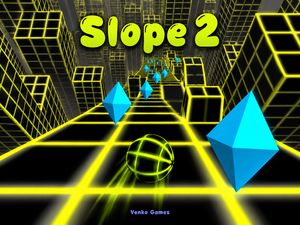
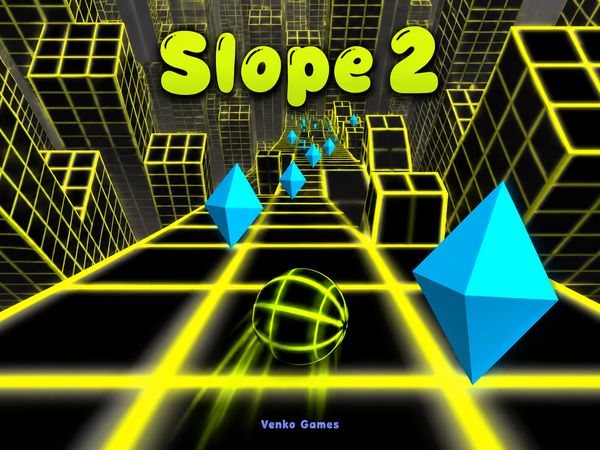
Slope 2 drops you onto a neon wireframe track and never lets you slow down. Your ball rolls faster every second, and one wrong nudge sends it into the void. This 3D endless runner takes the original's pure-reflex formula and adds moving hazards, collectible diamonds, and ball customization.
The whole game comes down to two keys and your nerve. You steer left and right, and the track does the rest. There is no brake and no jump, so every run tests how calmly you can read what rushes toward you.
Ready to see how far you can roll? Start a run right here in your browser and learn the track one crash at a time.
Physics and Momentum in Slope 2
Relentless Downhill Acceleration
The track points down, and your ball never stops falling along it. Speed builds on its own from the first second. You can't brake, and you can't hold anything back. The game gives you no way to slow down.
That one fact shapes every decision you make. A turn that feels easy at the start becomes a knife edge a minute later, because the same input now moves the ball much farther. The track doesn't get more complicated so much as you get less time to answer it.
Think of the run as a clock that keeps shrinking your reaction window. Early on, you have room to correct sloppy moves. Later, the gap between spotting a hazard and reaching it narrows to a blink. Wireframe visuals over a black void keep hazards readable at that pace, so your eyes can stay ahead of the ball.
Steering uses A and D or the Left and Right Arrow keys. Pick one pair and stick with it. Switching between them mid-run costs you the muscle memory you need when everything speeds up. Since acceleration is constant, your only real tool is where you place the ball, not how fast it travels.
Micro-Steering Versus Overcorrection
Hold a key too long and the ball slides off the edge. That is the most common way runs end. At high speed, a long press sends you sideways much farther than you planned.
Tap instead. Quick, feather-light taps nudge the ball just enough to line it up. If you drift, tap the opposite key once and release. Chasing a wobble with big corrections only creates a bigger wobble. Smooth, small inputs keep you centered when the ball is moving fastest.
Navigating Dynamic Neon Hazards
Deadly Red Blocks and Walls
Red means death. Lethal red obstacle blocks sit on the track, and touching one ends your run on the spot. These are the stationary threats the original game was built around, and they still make up much of the danger here.
Read the layout early. Blocks appear in clusters, and the gaps between them decide your line. Look past the nearest wall to the one behind it so you can plan two moves at once. Reacting only to what's right in front of you leaves no room to set up the next dodge.
The high-contrast wireframe palette helps. Red stands out sharply against the dark void and the neon track. Trust your eyes and commit to a lane before you arrive, since late swerves at speed usually end in a slip off the edge.
Moving Launchpads and Shifting Tracks
Here the sequel parts ways with the original. Platforms and barriers move, so a clear lane can close as you approach it. Static memory stops working, because you can't memorize a layout that keeps shifting.
Watch the motion, not just the position. Time your approach so you arrive when the path is open, and expect lateral hazard gates to cut across your line. Stay flexible and keep your taps small so you can adjust without overcommitting.
Narrow Gaps and Drop-offs
Some sections squeeze the track thin or leave open space between platforms. A bottomless drop ends a run just as fast as a red wall. Center the ball early, then hold your line with tiny taps rather than wide swings.
Mastering Track Transitions and Launch Ramps
Centering for Airborne Trajectory
Ramps throw your ball into the air, and you can't jump on your own. With no jump key, takeoff is the only moment that decides your flight. Whatever angle and position you have when you leave the ramp is what you carry through the air.
That makes alignment before the ramp everything. Get the ball centered a good distance ahead, not at the last second. A late correction right at the lip can push you sideways just as you launch, and you can't fix anything once you're airborne. Steering in the air doesn't rescue a bad launch.
Practice lining up early. As soon as a ramp comes into view, settle onto the middle of the track and stop moving. Let the ball roll straight off the edge. Straight takeoffs give you predictable landings, and predictability matters when the next platform is narrow and far away.
Speed makes the jump longer, so the farther you roll, the more distance you cover in the air. Expect to travel farther than feels natural, and set your position with that in mind.
Absorbing High-Speed Landings
Landing is where good launches pay off. You touch down already moving fast, often on a thin neon surface. Keep your hands light. A hard tap right at impact can skid you off the side.
Let the ball settle for a beat, then make small corrections. If you launched straight, you usually land straight, so trust it and save your taps for the hazard that follows the landing.
Diamond Collecting and the Slope 2 Shop
Risk Versus Reward Pathing
Collectible diamonds are a feature of this sequel, and they tempt you toward danger. The best ones tend to sit where the track is risky, which pulls you away from the safe center line. Every grab asks a question: is this gem worth the chance of a slip?
Discipline separates good runs from short ones. A diamond near the edge looks small, but chasing it at full speed can end everything. Grab gems that sit on your natural line and skip the ones that demand a wide swerve, especially when a hazard is close behind them.
Look ahead before you commit. If a diamond sits just before a red block or a narrow gap, you may not have time to recover after reaching for it. Treat gems as a bonus, not the goal. Your score comes from distance, so a long survival run beats a greedy one that ends early.
Unlocking New Ball Skins
Change how your ball looks and keep rolling.
Ready to chase some gems? Try Slope 2 right here and see how many you can grab without losing your line.
Run End States and Scoring Architecture
Collision and Void Pitfalls
There are no hit points, no second chances, and no partial damage.
That clarity helps you play. Only two things end a run, so you know exactly what to avoid. Stay on the track and stay off the red. Everything else you do, from collecting diamonds to lining up ramps, serves those two goals.
Because failure is instant, mistakes feel sharp but fair. You always see the cause, whether it was a long key press or a late dodge, and you can fix it next time.
Distance Scoring and High-Score Chasing
Your score comes from how far you survive. Staying alive longer means a higher number, full stop. To beat your best, focus on clean, steady rolling rather than risky grabs. Each new record is simply one more stretch of track you handled well.
If you like fast reflex runners, browse more in the Arcade collection, or try Snow Rider 3D, X Trench Run, and Cluster Rush for similar high-speed thrills.
Compare with Similar Games
| Game |
Why Similar |
| Cluster Rush |
Both games use a forward momentum navigation mechanic where missing a platform or colliding with obstacles causes an instant round failure. |
✨ Key Features of Slope 2
- Continuous downhill acceleration with zero mechanical braking
- Randomized, shifting 3D neon platforms suspended in space
- Collectible diamonds to unlock unique ball cosmetics
- Lethal red obstacle blocks and dynamic moving barriers
- Pure reflex arcade gameplay optimized for Unity WebGL
How to Play Slope 2
Step 1: Use the game controls
Use A Key to move left. Use D Key to move right. Use Arrow Left to move left. Use Arrow Right to move right.
Step 2: Start the Downhill Roll
Click into the game frame to focus your browser inputs and initiate the ball's automatic forward roll.
Step 3: Establish Lane Stability
Keep your sphere aligned with the center of the track by using short, feather-light taps of the A/D or Arrow keys.
Step 4: Scan Ahead for Red Obstacles
Focus your gaze several platforms ahead to spot stationary red cubes and dynamic sliding barriers before reaching them.
Step 5: Commit to Aerial Ramps
Center the ball perfectly before hitting steep elevation pads to ensure you land cleanly on disconnected downstream pathways.
Step 6: Bank High Scores and Diamonds
Survive as long as possible to maximize your distance score, grabbing accessible diamonds when your trajectory safely allows it.
Slope 2 FAQs
Can I play Slope 2 on mobile devices?
Slope 2 opens in a phone browser, but it is played with the keyboard, so a computer works best.
What are the basic controls for Slope 2?
Browser keyboard: A Key — move left; D Key — move right; Arrow Left — move left; Arrow Right — move right.
Do I need to download Slope 2?
No. Slope 2 runs in your browser on this page, with nothing to download or install.
How do runs end in Slope 2?
A run terminates instantly if your ball strikes any red wall, obstacle block, or barrier. Falling off the unbordered sides of the platforms into the open void also ends the attempt immediately and records your final score.
What purpose do diamonds serve in Slope 2?
Diamonds scattered along the downhill courses act as collectible currency. Gathering them allows players to unlock different cosmetic ball skins within the game shop.
Conclusion
Slope 2 is a 3D endless runner that runs right in your browser, built on Unity WebGL. It's a singleplayer experience with simple controls: steer left and right using the A and D keys or the Arrow Left and Arrow Right keys. That straightforward setup makes it easy to pick up in seconds.
The appeal lies in how quickly it pulls you in. With only two directions to manage, every run comes down to your reflexes and focus, which makes it great for short breaks or longer attempts to push further.
Ready to test your steering? Play Slope 2 here on this page and see how far you can go.

No comments yet. Be the first to share your thoughts!